Species
Freshwater Fish Species Found in Northern Italian Rivers
Northern Italy's river systems — the Po and its network of alpine and Apennine tributaries, the Adige, the Tagliamento, the Piave — hold one of the highest concentrations of endemic freshwater fish species in Europe. The geographic isolation created by the Alps to the north and the Apennines to the south and west, combined with the diverse habitat types found across the plain, has produced a fish fauna that diverged significantly from its central European counterparts over tens of thousands of years. Much of that diversity is now under pressure from introduced species, habitat modification, and altered flow regimes, making a working knowledge of what is native to each catchment more relevant than it might appear from a casual glance at the rivers.
The Po Catchment: Species Diversity Under Pressure
The Po basin is the largest river catchment in Italy by drainage area and once held an exceptionally diverse assemblage of native cyprinid species. Contemporary fish surveys conducted by the regional environmental agencies of Lombardy, Piedmont, and Emilia-Romagna consistently record between 28 and 35 fish species in larger sampling campaigns, but the native-to-non-native ratio has shifted markedly since the mid-twentieth century.
Among native species that remain relatively widespread in the middle and lower Po sections, the barbel (Barbus plebejus) is notable as a large, bottom-feeding cyprinid that requires clean gravel substrate for spawning. Its presence at a site is generally taken as an indicator of reasonable water quality and channel morphology. The nase (Chondrostoma soetta), a medium-sized cyprinid that grazes algae from rock surfaces in well-oxygenated sections, has contracted substantially from its former range but persists in sections of the Ticino, Oglio, and Mincio tributaries where water quality has remained adequate.
Introduced Species and Competitive Displacement
The introduction of European catfish (Silurus glanis) into the Po system — documented from at least the 1970s in the Mantova stretch — has significantly altered the predator-prey structure in the lower river. Catfish now reach 1.5–2 metres in length in the main channel, feeding on cyprinids, waterfowl, and occasionally small mammals. Their effect on native barbel and nase populations in the lower Po is considered substantial, though direct evidence is confounded by the simultaneous impact of habitat degradation.
Eastern mosquitofish (Gambusia holbrooki), pumpkinseed sunfish (Lepomis gibbosus), and largemouth bass (Micropterus salmoides) are all well established in the irrigation canal networks and ox-bow lakes connected to the Po plain. These species have largely displaced native small cyprinids — particularly bleak (Alburnus alburnus) and moderlieschen — from the slower, warmer water habitats.
The Adige and the Marble Trout
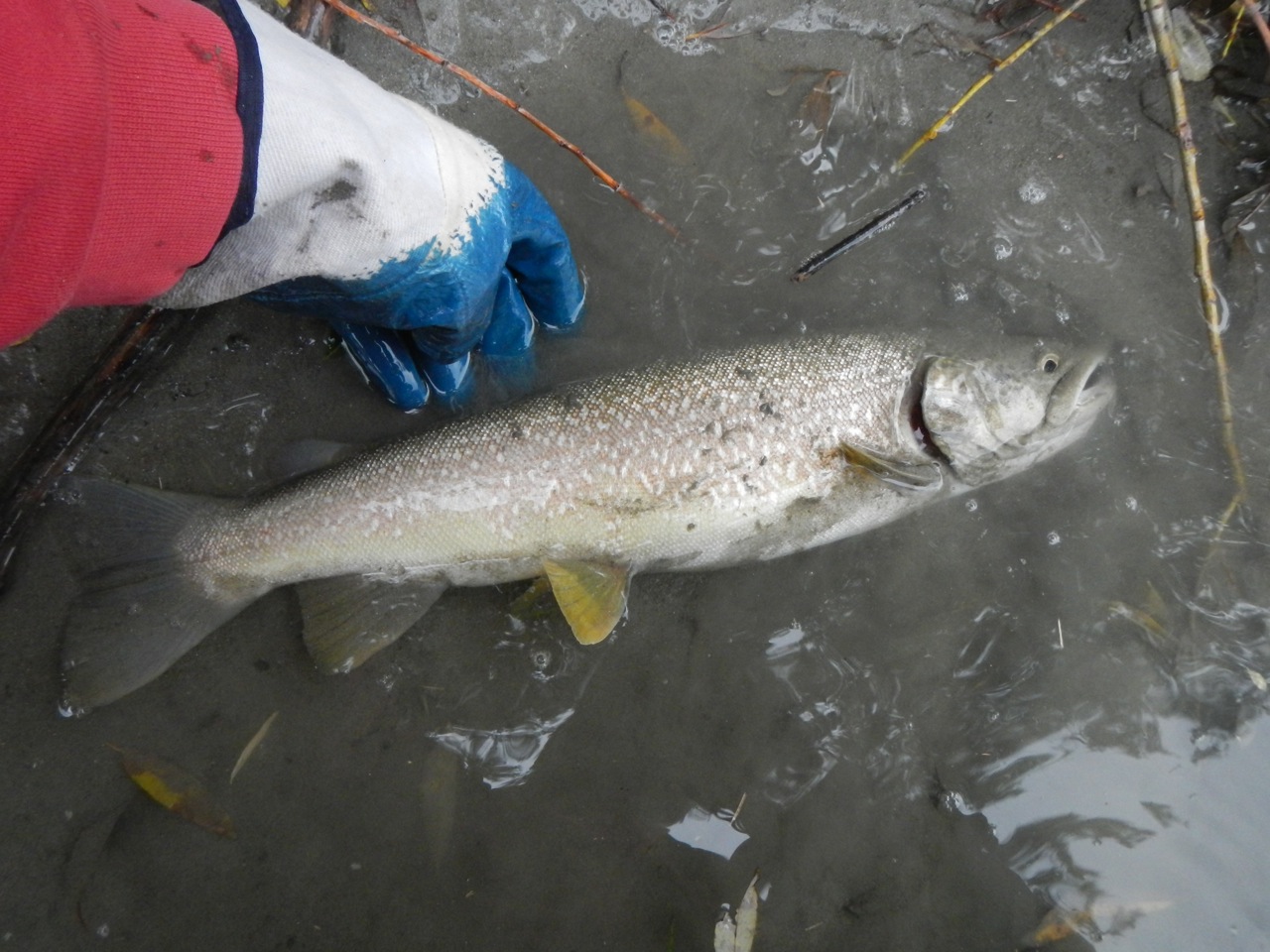
The marble trout (Salmo marmoratus) is among the most ecologically significant freshwater fish in northern Italy and one of the most visually distinctive salmonids in Europe. Its marbled pattern — irregular dark blotches on a greenish-brown base — is unique among European trout. The species is native to the Adriatic drainage basin, with its core range encompassing the upper Adige, the Isonzo (Soča) in Slovenia, and several smaller tributaries flowing into the Adriatic.
In the Adige catchment, marble trout are found in the cleaner, faster-flowing sections above Bolzano and in the upper Val Venosta tributaries. The species is under serious conservation pressure from hybridisation with introduced Atlantic brown trout (Salmo trutta of non-native origin), which were stocked extensively in Italian alpine rivers during the twentieth century for sport fishing. Genetic surveys conducted from 2005 onward have found that pure marble trout populations persist in only a handful of isolated upper-catchment sections, typically above natural migration barriers such as waterfalls that prevent contact with brown trout from below.
Huchen in the Adige
The Danube salmon or huchen (Hucho hucho) reached the Adige system through the historic connection of Alpine lake systems and was historically distributed in the larger tributaries of the upper valley. It is now extremely rare in Italian waters — the IUCN classifies the species as Endangered — and any confirmed sighting in the Adige system is treated as ecologically significant. The few individuals occasionally reported in the Noce and Avisio tributaries represent either residual wild fish or strays from stocking programmes in the Austrian portion of the catchment.
The Tagliamento: A Reference Catchment
The Tagliamento in Friuli-Venezia Giulia is often cited in European river ecology literature as one of the last morphologically intact large river systems in the Alps. Its braided channel structure, mobile gravel bars, and seasonally flooded forest margins maintain habitat conditions that other northern Italian rivers lost through flood-control engineering during the nineteenth and twentieth centuries. The fish community in the Tagliamento reflects this morphological integrity.
The Italian nase (Chondrostoma soetta) reaches higher densities in the Tagliamento than in most of the Po catchment. The endemic sofie (Telestes souffia), a small cyprinid that requires well-oxygenated water over clean gravel and pebble substrate, is found throughout the middle catchment. Marble trout occur in the upper Tagliamento and several tributaries, and hybridisation pressure from brown trout is lower here than in the more intensively stocked parts of the Adige, partly because the river's natural dynamism reduces the effectiveness of trout stocking for sport fisheries.
Field Identification Notes
For observers unfamiliar with Italian freshwater fish, several characteristics help with field identification of the most ecologically significant species:
- Marble trout: The marbled pattern is diagnostic. No other European salmonid has this coloration. Fish in the 40–80 cm range are not uncommon in productive reaches.
- Barbel (Barbus plebejus): Four barbels at the mouth, elongated body, reddish-orange lower fins. Typically found in faster, shallower water over gravel.
- Nase (Chondrostoma soetta): Distinctive downturned mouth adapted for algal grazing, silver body with a slightly flattened underside. Seen most easily in shallow, clear water.
- Huchen: If encountered, the elongated body, small scales, and torpedo-shaped head distinguish it from brown trout. Any sighting in Italian rivers warrants reporting to the regional environmental agency.
Relevance to Otter Ecology
The fish species profile of any river section determines much of what otters can eat there. In the Tagliamento, where native cyprinids and marble trout remain relatively abundant, otter diet reconstructed from spraints reflects that diversity — chub, barbel, nase, and occasionally salmonids all appear in analysed samples. In the more degraded sections of the lower Po, otter diet shifts heavily toward introduced species, particularly catfish juveniles and bream, which are more consistently available in the altered habitat.
This connection between fish community composition and otter diet means that fish survey data is one of the most useful secondary sources for anyone trying to understand otter territory use and population viability at the catchment scale.
Further Reading
The FishBase database provides species-level distribution, ecology, and taxonomy for all species mentioned here. Regional fish monitoring reports for Lombardy, Veneto, and Friuli-Venezia Giulia are published periodically by the respective regional environmental protection agencies (ARPA).